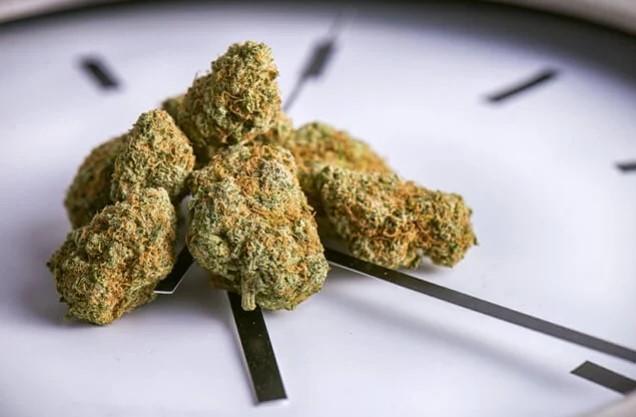
Why drying and curing matter
Freshly harvested cannabis flower is about 78 to 80% water, according to a 2019 review of cannabis cultivation and post-harvest practice. Removing most of that water is what limits microbial growth and slows deterioration in storage, as Oregon State University Extension explains in its post-harvest guide for hemp flowers.
Curing comes after drying. A 2022 review in Bioengineering describes it as the point where drying ends and storage begins, with the dried buds kept in closed containers at a steady moisture level. Both the review and OSU Extension point out that curing has had little formal research, so most curing advice is still grower practice rather than tested science.
Before you dry: harvest timing and trimming
Drying cannot fix a crop cut at the wrong time. Leafly's harvest guide says to look for milky white trichomes before harvesting, since clear ones are not yet ripe; how to read trichomes explains what to look for under magnification. If this is your first plant, the beginner guide to growing weed covers everything up to harvest.
You can trim leaves right after harvest (wet trimming) or once the plant has dried (dry trimming). Per Leafly's drying guide, wet-trimmed buds come off the branch and dry on flat mesh racks, while dry trimming lets you hang whole plants or branches; the extra plant matter makes the dry slower, which can help in a dry room. The trade-off: dried leaves shrivel and get harder to trim, and trichomes turn brittle, so dry-trimmed buds need gentle handling.
The right drying conditions
Aim for a dark, undisturbed room at 15 to 21°C and 45 to 55% relative humidity, checked with a thermometer and hygrometer. Commercial practice sits in the same range: the Bioengineering review and OSU Extension both give 18 to 21°C and 50 to 55% humidity for slow drying, and a Cannabis Business Times survey of cultivators found an average drying-room temperature of 65°F (about 18°C) and humidity of 53%. In the same report, researcher Markus Roggen said his team found the optimal drying window to be 60 to 74°F and 40 to 60% humidity.
- Darkness: storage research summarized by OSU Extension found that light, air and high temperatures all reduce some cannabinoids, so keep the room dark.
- Gentle airflow: a fan moving the room air, plus a dehumidifier or air conditioner if humidity climbs, as Leafly's drying guide suggests.
- The 60/60 rule: many growers aim for 60°F (about 16°C) and 60% humidity. Dr. Allison Justice, who presented drying studies run with a Clemson University lab, called it the rule "everybody knows" in a talk on drying and curing research. Treat it as a rule of thumb, not a tested optimum.
- No sun, no heat: the 2019 review warns against drying crops on the ground or in direct sunshine.
How to hang-dry cannabis, step by step
- Cut the plant into branches you can hang, removing the large fan leaves as you go.
- Hang the branches upside down from a line or rack with space between them, so air reaches every bud.
- Keep the room closed, dark and out of reach of children and pets, and expect a strong smell for the whole dry.
- Check the thermometer and hygrometer daily and adjust the fan or dehumidifier to stay in range.
- Start checking buds after the first few days. Denser buds take longer, so test several sizes before you move anything to jars.
How long does it take to dry weed?
How long it takes depends on the method and the room. Roggen told Cannabis Business Times that 10 to 14 days worked well for his team, while Leafly's drying guide puts drying at about 2 to 7 days, shorter for wet-trimmed buds because there is less plant matter to dry. Faster is not better. In the research Justice presented, buds dried within 6 days came out unevenly, drier outside than inside, and likely lost terpenes to the extra heat, while drying too slowly raised the risk of mould. She put the sweet spot at about 7 to 10 days.
Heat speeds things up a lot: the 2019 review cites hanging plants reaching 15% moisture in 36 hours at 30°C and in 11 hours at 50°C. The same review notes that 24 hours above 37°C may start decarboxylating cannabinoid acids, and it flags terpene loss during heating as a concern, which is why ovens, microwaves and space heaters make a poor shortcut.
How to tell when buds are dry enough
Buds are ready for jars when they feel dry to the touch but still hold a little moisture inside, and the small stems snap rather than flex when you bend them; Leafly's drying guide uses the same snap test. If you own a water activity meter, Justice describes 0.6 to 0.65 as the range that suits smoking while limiting botrytis risk, and OSU Extension gives below 0.65 as the target once flower moves into curing and storage. As a rough rule, buds that crumble to dust went too far, and buds that feel spongy need more time.
How to cure cannabis in jars
Curing means storing the dried buds in airtight containers so the moisture left inside them can spread out evenly.
- Put the dried, trimmed buds loosely into clean, airtight glass jars and keep them somewhere dark, cool and dry, as Leafly's drying guide describes. Light can degrade terpenes, Leafly adds, so cover the jars or use opaque or tinted glass.
- Burp the jars: open them for a few minutes every day for the first week, then every few days after that, to let excess moisture escape.
- Watch the humidity inside the jar. One study cited in the 2019 review cured dried flower at 18°C and 60% relative humidity for 14 days; a small hygrometer or a humidity pack in the jar helps you hold that level.
- Cure for at least 2 weeks. Leafly says 2 to 4 weeks is usually enough, though some people prefer 4 to 8 and some strains benefit from even longer.
What happens in the jar, and when the cure is done
Do not panic if the buds feel a little softer after a day in the jar. In the jar studies Justice presented, humidity in the space above the buds rose after sealing because moisture was moving from the centre of each bud to the outside, not because the buds were getting wetter. The same work found oxygen falling and carbon dioxide and ethylene rising in sealed jars, a sign the tissue is still respiring. Burping lets the excess moisture out; whether the trapped gases matter is still an open question, Justice said.
A finished cure usually shows itself this way: the buds soften slightly, the strain's aroma comes through with no grassy or hay-like smell, and the flower burns evenly. Beyond that, a good cure is partly a matter of taste. One researcher quoted by Cannabis Business Times said a good cure is currently defined by the person who smokes it and likes it.
Mould: how to spot it and how to prevent it
Moisture is the main risk at every stage. A 2019 study in Frontiers in Plant Science found Penicillium, Botrytis and Fusarium species on cannabis buds, and all three caused browning and decay when buds were kept in high humidity. Botrytis bud rot shows up as brown, discoloured and decaying tissue, with fungal growth developing inside the bud.
Some moulds are a health concern, not just a quality problem. OSU Extension guidance on Aspergillus in hemp notes that certain Aspergillus species produce toxins called aflatoxins, that the fungus can keep spreading in storage when conditions are not controlled, and that people with weakened immune systems are more prone to Aspergillus lung infections. If you find fungal growth or rot, throw the affected buds out. Not sure what you are looking at? See how to tell mouldy weed from trichomes.
- Keep the drying room inside the temperature and humidity range above, and do not jar buds that still feel damp inside.
- Burp on schedule during the first weeks of the cure.
- Store in glass rather than plastic; OSU Extension advises against plastic storage and packaging to reduce pathogen growth.
- Clean tools and surfaces with an alcohol solution, and keep eating, drinking and smoking out of the processing area.
Storing cured weed
Once cured, keep flower in airtight glass somewhere cool and dark. Temperature matters: the 2019 review reports THC breaking down by about 3.83% a year at -18°C, 5.38% at 4°C and 6.92% at 22°C. Keep it locked away from children and pets, as Health Canada advises for people growing at home.
Buying cured flower instead
If you would rather skip the weeks of drying and curing, GasDank offers same-day delivery across Toronto and the GTA, usually within 1 to 2 hours, and mail order across Canada. The menu carries lab-tested products; browse all flower. Customers must be 19 or older (21 in Quebec), and ID is checked at the door.