
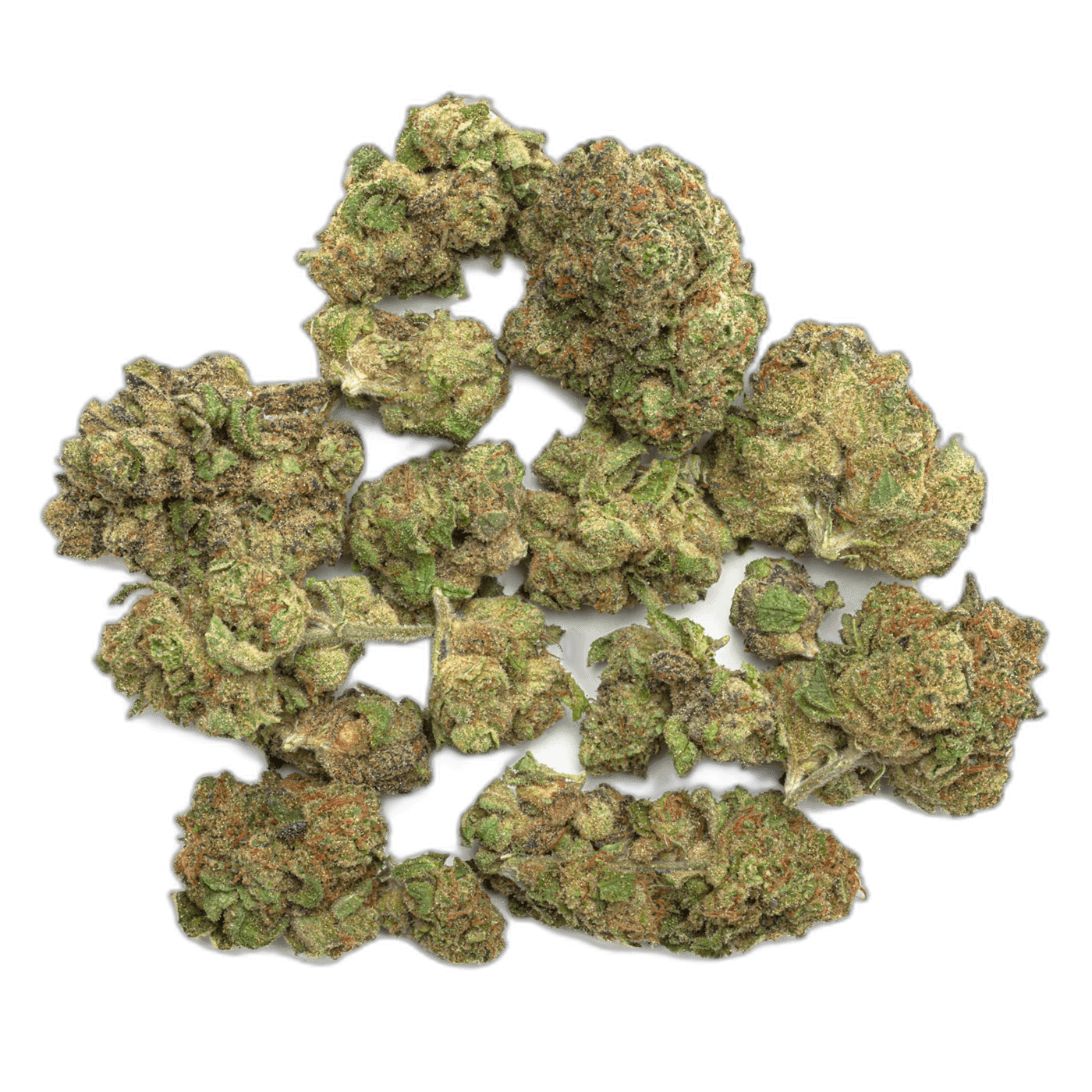
Hindu Kush Overview: Origin & Landrace History
Hindu Kush is a pure landrace indica that evolved over centuries in the Hindu Kush mountain range straddling Afghanistan and Pakistan. It is one of the oldest documented cannabis cultivars on earth and the genetic template for the classic indica: short, dense, heavily resinous and deeply calming. Modern harvests typically test between 18% and 25% THC — serious potency for a strain that was never engineered in a lab.
A landrace is a cannabis variety that adapted to a single region over hundreds of generations without deliberate human crossbreeding. Isolated by high-altitude terrain, Hindu Kush stabilized into a true-breeding population, meaning its seeds reliably grow into plants with the same structure, aroma and effects every time. That genetic uniformity is nearly extinct in a market built on constant hybridization.
Landraces matter because they are the raw material every modern menu is built from. Breeders return to them for stable, proven traits — resin output, hardiness, predictable effects — the way distillers return to heritage grains. Lose the landraces and cannabis loses its reference points, which is why purists treat Hindu Kush as living history rather than just another jar on the shelf.
The strain's influence is hard to overstate. Hindu Kush genetics underpin countless modern Kush strains, including Pink Kush, the OG Kush family and most of the heavy indicas dominating Canadian menus today. The word Kush itself comes from these mountains, so every strain name that carries it is borrowing this plant's credibility.
Hash heritage is the other half of the story. For centuries, growers in the region hand-rubbed live plants to collect charas and dry-sifted cured ones for pressed hashish, selecting year after year for maximum resin. Hindu Kush stands as one of the foundational hash-making cultivars on the planet because generations of farmers bred it to be exactly that.
The strain is commonly reported to have travelled west in the 1960s and 1970s with overland travellers returning from Afghanistan, after which it anchored early North American breeding programs. Unlike most cultivars of that era, it never fell out of circulation. Five decades of continuous demand is its own form of quality control.
Its age also predates the entire indica-versus-sativa marketing era. When botanists first described broad-leaf cannabis from Afghanistan, plants like Hindu Kush were the reference specimens, which is why the strain still gets cited in discussions of what indica originally meant. Very few products in any category can claim to have defined their own label.
For Toronto buyers, the practical takeaway is consistency. Because the genetics are stable, the Hindu Kush you order this month should look, smell and hit like the one you order next month — something this year's hype drops rarely manage. It is the closest thing cannabis has to a benchmark product.